

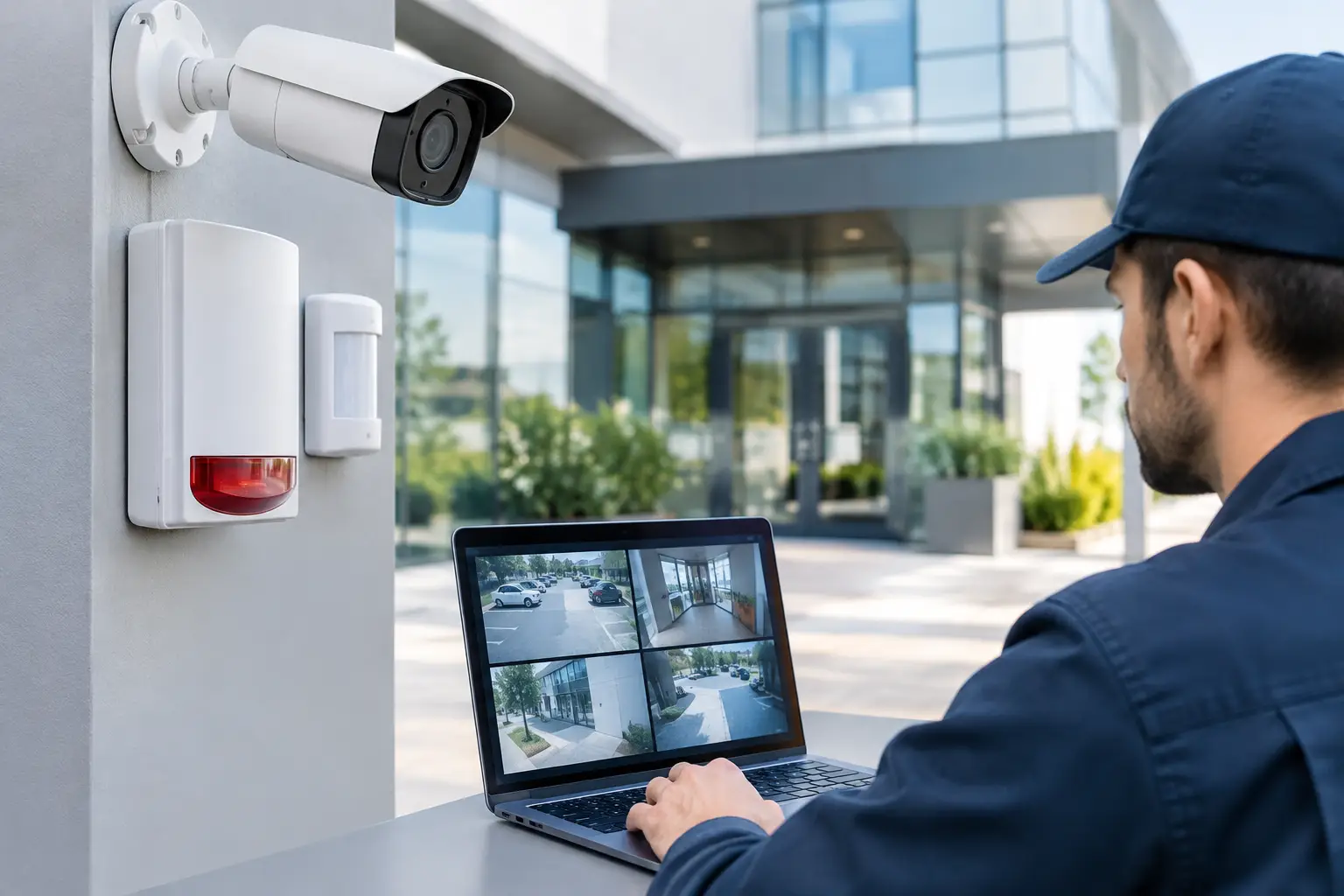
How to Integrate CCTV Alarms in Commercial Sites
A CCTV camera that records an intruder after they have left offers evidence. A camera that responds when an alarm activates can help stop the incident while it is still developing. Knowing how to integrate CCTV alarms turns separate security products into a coordinated response system, giving teams clearer information when time matters most.
For commercial and industrial premises, integration is not simply a matter of connecting an alarm panel to a recorder. It requires a considered design around site risk, alarm priorities, network resilience, operator workflows and the response expected outside normal operating hours. The right approach reduces false call-outs, shortens verification time and gives security personnel the context required to act decisively.
What CCTV and alarm integration should achieve
An integrated system links intrusion detection with video surveillance so an event in one system triggers a relevant action in the other. For example, a detector activating in a loading bay after hours can instruct nearby cameras to move to a preset position, begin high-priority recording and present the live image to a monitoring operator.
This changes the quality of the alarm response. Rather than asking a keyholder or control room to attend every activation with limited information, authorised personnel can assess whether the event appears to be a genuine intrusion, an environmental issue or an operational activity that was not correctly scheduled.
The commercial outcome is better control, not simply more technology. Security managers gain a more reliable audit trail, facilities teams can identify recurring issues at vulnerable doors or compounds, and organisations can focus response resources on events that require intervention.
Start with the site risks and response plan
Before selecting integration methods, map the events that matter most at each site. A perimeter breach, forced door, duress alarm, restricted-area movement and plant-room access may each need a different camera view and escalation route. Treating every event identically can overwhelm operators and dilute the urgency of a high-risk activation.
Consider how the building operates across a full week, not just during office hours. A warehouse may have early deliveries, a manufacturing site may run night shifts, and a financial location may have controlled access periods around cash handling or ATM servicing. Alarm schedules, access permissions and CCTV rules need to reflect these patterns.
The response plan should also establish who receives an alarm, what they can see, what authority they have and when emergency services or guarding providers are contacted. Video verification can provide valuable context, but it does not replace clear procedures, trained operators or an appropriate response agreement.
Define priority zones
Divide the premises into meaningful zones based on asset value, consequence and likelihood of unauthorised access. A boundary fence may need broad coverage and immediate illumination. A server room, key cabinet, safe area or high-value stock cage may require multiple camera angles, tighter alarm logic and a faster escalation process.
For each zone, document the trigger device, associated cameras, recording requirements, preset positions, alert recipients and expected action. This design record is essential when systems are commissioned, maintained or expanded across further locations.
Choose the right integration architecture
How CCTV alarms are integrated depends on the equipment already in place and the level of control required. At its simplest, hardwired inputs and outputs can relay an alarm activation to a network video recorder or video management system. The recorder can then mark footage, trigger recording profiles or send an alert.
For more capable environments, integration through supported software platforms or application programming interfaces can connect intrusion alarms, CCTV, access control, intercoms and monitoring services. This provides richer event information. An operator may see the alarm location, associated live camera feeds, door status and recent access activity within the same operational view.
Cloud-connected video and access platforms can support multi-site estates, particularly where central teams need consistent visibility without maintaining separate local workstations at every location. However, cloud architecture must be assessed against bandwidth, retention, cyber security controls, privacy requirements and the availability of a suitable fallback process if connectivity is disrupted.
Avoid relying on unsupported or improvised connections between manufacturers. A system may appear to function at handover but become difficult to maintain after updates or equipment replacement. Supported integrations, clearly documented interfaces and properly configured user permissions provide a stronger foundation for long-term service continuity.
Configure camera actions that help operators
Alarm-triggered camera behaviour should be purposeful. A pan-tilt-zoom camera can move to a stored preset overlooking a gate, yard entrance or corridor. Fixed cameras can be grouped so an operator receives both a close identification view and a wider scene view. Recording can switch from standard schedules to event-led capture with pre-alarm and post-alarm footage retained.
Pre-alarm recording is particularly useful. It shows what occurred immediately before the detector activated, helping operators distinguish a person approaching a protected area from an expected event such as a roller shutter moving during authorised operations.
Do not automatically move every camera on every activation. A camera that repeatedly leaves its usual field of view may miss activity elsewhere. Critical locations often benefit from a combination of fixed overview cameras and controllable cameras used for investigation.
Lighting, audio warnings and security fogging may also form part of the response at suitable sites. These measures require careful risk assessment and a clear escalation design. An automatic deterrent that activates in the wrong circumstances can disrupt legitimate work and create avoidable operational issues.
Connect access control for better event context
CCTV and alarms are most effective when they are informed by access activity. If a door alarm activates, the system should help establish whether the door was opened by a valid credential, forced without authorisation or held open beyond an agreed time.
With intelligent access control, authorised events can suppress or qualify certain alarms during defined periods, while suspicious events can prioritise camera views. For example, a card presented at an external door followed by forced entry through a nearby emergency exit is a different risk profile from a scheduled contractor entering a permitted area.
This is where integrated physical security becomes operational infrastructure. Permissions can be managed remotely, activity can be audited, and investigations can move from separate logs and recordings to a clearer sequence of events. The design must still protect privacy and ensure only appropriate users can view footage or access event data.
Design for network security and resilience
An alarm-to-video integration is only as dependable as the infrastructure supporting it. Segregate security devices from general business traffic where appropriate, use managed network equipment and control remote access with strong authentication. Default passwords, exposed recorders and poorly managed installer access create unnecessary risk.
Power resilience also deserves attention. Cameras, switches, alarm panels, routers and recording equipment may need uninterruptible power supplies, with capacity based on the required operating period. At larger or higher-risk sites, consider what happens if a communications cabinet, local power supply or internet connection fails.
Retention requirements should be agreed in advance. The right storage period depends on risk, operational needs, data protection obligations and the organisation's investigation process. Higher-resolution footage and continuous recording improve detail but increase storage demand. Event-led recording can reduce capacity requirements, although it may not be suitable for every critical area.
Commission, test and maintain the integration
Commissioning is where an integrated design proves its value. Every trigger should be tested against the intended outcome: does the correct camera display, does it move to the correct preset, is the relevant footage retained, does the alert reach the right person, and does the response procedure make sense in practice?
Testing should include realistic exceptions. Check after-hours alarm settings, authorised late access, loss of network connection, power recovery and alarms triggered in quick succession. If the system is monitored remotely, test the communication path and the information available to the receiving centre.
Provide operators with concise instructions tailored to their role. A facilities manager may need to acknowledge a notification and contact a keyholder, while a control room operator may need to review video, classify the event and follow an agreed escalation path. Training should cover both normal activity and fault reporting.
Ongoing maintenance is not an optional extra. Camera views can be blocked by new racking, vegetation or building alterations. Detector sensitivity, firmware compatibility, storage health and network performance can all change over time. Planned inspections and documented testing preserve the reliability of the original design.
Build a system that can grow with the estate
A single-site installation may later need central monitoring, additional cameras, upgraded access control or new protected zones. Select systems that can scale without forcing a full replacement, and keep accurate records of device addresses, licences, network settings and integration rules.
For organisations managing complex or multi-site premises, specialist design and commissioning can prevent the common gap between products that work individually and a system that works under pressure. Loktec Security Group combines CCTV, intrusion detection, intelligent access control and nationwide support to help organisations build security infrastructure around real operational requirements.
The best integrated CCTV alarm system is not the one with the greatest number of notifications. It is the one that gives the right people trustworthy visual evidence, at the right moment, so they can protect people, assets and operations with confidence.



Comments