

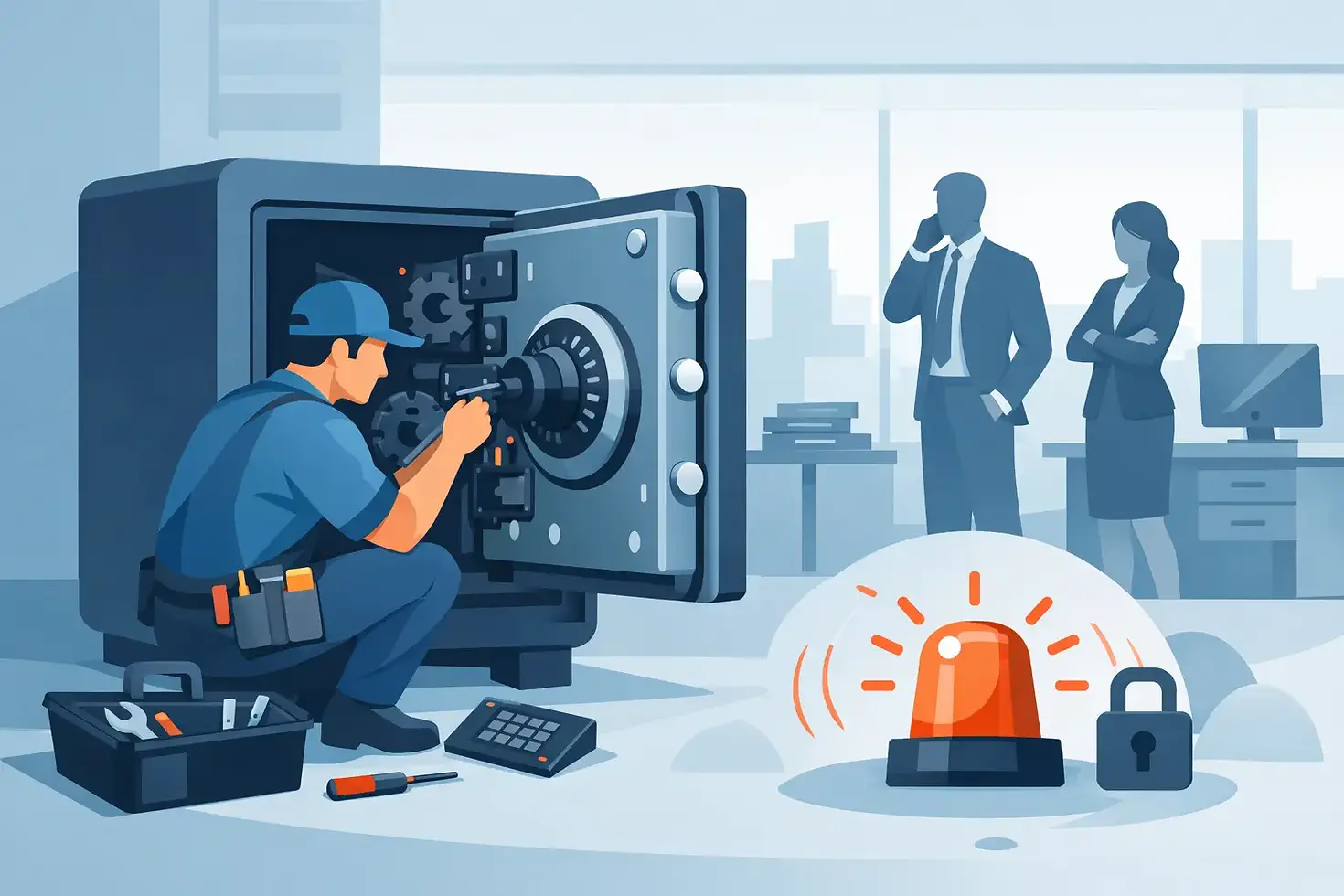
When Safe Lock Repair for Businesses Is Urgent
A safe that will not open before payroll, a vault lock showing intermittent faults, or a key that suddenly turns without engaging is not a minor facilities issue. Safe lock repair for businesses protects the assets inside the unit, but it also protects operational continuity, staff safety and the chain of accountability around high-value access.
For commercial and industrial organisations, the right response is rarely force. It is a controlled technical assessment that restores access without compromising the safe, its contents or the evidence trail around who has handled it. The urgency may be high, particularly where cash, controlled medicines, confidential documents, keys, data media or critical equipment are held inside. That does not make an improvised repair the right choice.
Why safe lock faults need a business response
A commercial safe is part of a wider security system. It may sit behind an access-controlled door, support cash-office procedures, protect master keys or provide a final layer of security for sensitive assets. When its lock fails, the impact can extend well beyond the person standing in front of it.
A lock that cannot be secured may leave assets exposed. A lock that cannot be opened can delay banking, stop authorised staff accessing essential documents or force teams to hold valuables elsewhere. Repeated faults can also create risky workarounds, such as sharing override credentials, leaving a safe unlocked during busy periods or relying on a single keyholder with no contingency plan.
There is also a governance issue. Safes often support procedures designed for dual control, restricted access and auditable responsibility. Any repair activity should preserve those controls. A competent specialist will establish who is authorised to instruct the work, confirm ownership or authority where appropriate, document the condition of the unit and agree how access will be managed once the repair is complete.
Recognising the warning signs early
Safe locks seldom fail without some indication that performance has changed. Mechanical locks may become stiff, require several attempts to operate or show inconsistent key movement. Electronic locks may display low-battery warnings, reject known user codes, lose time settings or behave unpredictably after a power issue.
The most useful action is to record the pattern rather than repeatedly trying combinations or applying force. Note when the problem started, whether it affects every authorised user, what appears on the display and whether there have been changes to site power, temperature, building works or operating procedures. These details help a locksmith or security engineer diagnose the issue efficiently.
Do not use lubricants, drill the unit or attempt to bypass the lock without professional direction. The wrong product can damage internal components, while forced entry may turn a repairable lock fault into a costly safe replacement. It may also invalidate insurance conditions or create questions about asset custody.
Mechanical, electronic and connected locks fail differently
The repair approach depends on the lock technology and the safe's certification, construction and intended use. A traditional key lock may require key cutting, cylinder work, boltwork adjustment or replacement of worn internal parts. Combination locks can develop issues with dials, cams, relockers or tolerances that need precise adjustment.
Electronic locks introduce a different set of considerations. The fault may be related to batteries, contacts, keypad wear, user programming, lock electronics or the interaction between the lock and safe boltwork. Replacing batteries is sometimes straightforward, but only when the lock design permits it and the procedure follows the manufacturer's requirements. A rushed battery change can trigger a lockout or leave an audit trail incomplete.
Where a safe forms part of a wider connected security environment, repair planning should consider credentials, time delays, dual-authorisation rules and event records. Technology improves control, but it also means a repair should be carried out by someone who understands both physical locking mechanisms and the operating logic behind them.
The right process for safe lock repair for businesses
Effective repair begins with triage. The priority is to establish whether the safe is currently secure, whether access is urgent and whether the fault presents a safety, insurance or operational risk. A specialist can then determine whether remote guidance, a scheduled attendance or an emergency response is appropriate.
On site, the work should begin with inspection and diagnosis, not assumptions. The engineer will assess the lock type, safe construction, boltwork operation and visible signs of damage or attempted entry. They should also identify whether the fault lies in the lock itself or elsewhere in the mechanism. A jammed bolt, misaligned door, damaged hinge or failed relocker can appear to be a lock problem when it is not.
If opening is required, non-destructive methods are the first objective wherever feasible. In some circumstances, particularly following serious damage or internal failure, specialist opening work may be necessary. This is a trade-off: the fastest route to access is not always the route that best protects the safe's future security rating, appearance or serviceability. The chosen method should be explained clearly, along with the likely restoration work afterwards.
Once access is restored, the job is not finished. A proper repair includes testing lock operation repeatedly, checking the safe can secure correctly, resetting authorised codes or credentials, and confirming that the right people understand the new operating process. Where keys, combinations or administrator codes have been exposed during the incident, they should be changed as part of the recovery plan.
Repair, upgrade or replacement?
Repair is often the right commercial decision when the safe body remains sound and the fault is isolated to a serviceable lock or component. It can restore protection quickly and avoid the disruption of removing a heavy unit from a live site.
However, replacement or an upgrade may be more sensible where locks are obsolete, parts are unavailable, faults recur or operational needs have changed. A business expanding to longer opening hours, multiple locations or larger cash volumes may outgrow a basic standalone lock. Electronic locking can provide individual user codes, time-based access, dual control and audit capability, depending on the model and application.
The decision should be based on risk and total cost, not simply the immediate call-out price. Consider the value and type of assets stored, insurance requirements, the number of authorised users, frequency of access, resilience needed during staff absence and the cost of future disruption. A low-cost repair that leaves a critical safe dependent on a single ageing key can become expensive at the next failure.
Build safe maintenance into security operations
Many organisations service alarms, CCTV, access control and fire systems to maintain availability and evidence compliance. Safes and vault locks deserve the same planned attention, particularly in cash handling, retail, logistics, healthcare, finance and high-value manufacturing environments.
A sensible maintenance plan records the safe make, model, lock type, location, asset owner and authorised contacts. It also defines how batteries are checked, who holds emergency instructions, when codes or keys are changed, and what happens if a keyholder leaves the organisation. These arrangements reduce delay when an urgent fault occurs and prevent a routine repair becoming an access-control incident.
Physical security is strongest when its layers work together. Master key systems, intelligent access control, key cabinets, intrusion detection and CCTV can each support the operational controls around a safe. For example, access records can confirm who entered a cash office, while managed key systems reduce the risk of uncontrolled emergency keys circulating around a site.
Choosing a specialist partner
Safe lock repair calls for more than general locksmith availability. Businesses should look for a provider able to work with commercial safe and vault hardware, assess the wider security implications and support both urgent incidents and planned improvements. Nationwide coverage matters for multi-site estates, but so does consistent documentation, clear escalation and a service team that can take responsibility after the immediate fault is resolved.
Loktec Security Group combines specialist locksmith capability with integrated physical security engineering, helping organisations treat safe protection as part of a coherent operational security strategy. That matters where a repair leads to a wider requirement, such as upgraded access control for a restricted room, managed keys or improved monitoring around high-value assets.
A safe lock fault is a moment to restore control, not merely regain entry. With the right diagnosis, authorised process and forward-looking repair decision, the business can return to normal operation with stronger protection than it had before.


.png)
Comments