

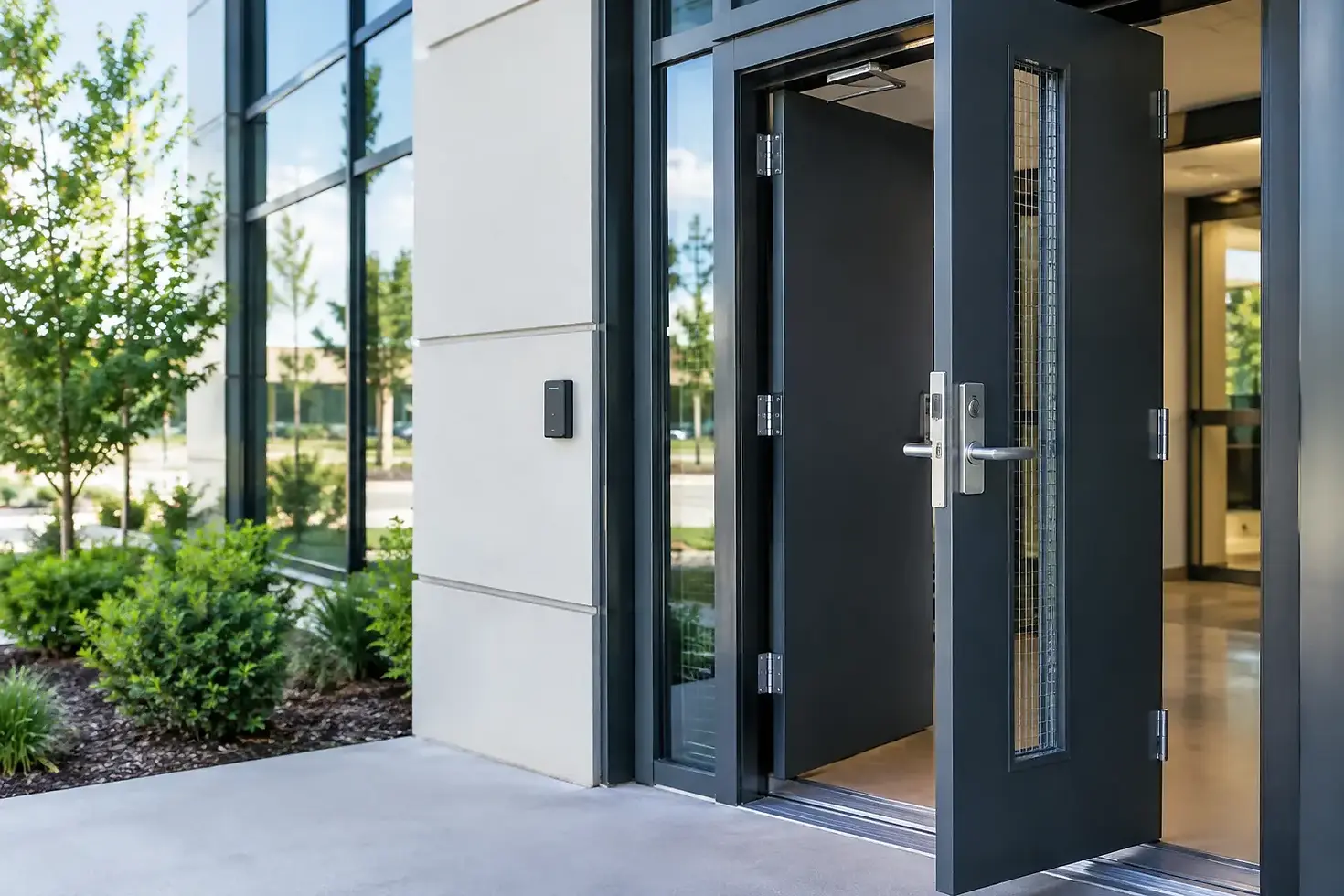
Security Doors for Commercial Sites That Perform
A loading-bay door that is secure on paper but left propped open during deliveries is not protecting the building. Nor is a plant-room door that cannot be quickly accessed by authorised engineers, or a records-store entrance with no audit trail of who entered. Security doors need to do more than resist forced entry. In commercial and industrial settings, they must support the way a site operates while creating a dependable boundary around people, assets and sensitive areas.
For facilities and security teams, the right decision is rarely simply a matter of selecting the strongest-looking steel door. It is about specifying a complete doorset that reflects the risk at that location, integrates with access control and remains reliable through years of intensive use.
Security doors are part of a wider control strategy
A security door is most effective when it is considered as part of the whole opening. The door leaf, frame, hinges, lock, cylinder, closer, panic hardware, glazing and installation all influence performance. A weak frame, incorrectly fitted lock or unsuitable hardware can undermine an otherwise high-specification door.
This matters particularly at perimeter entrances, service yards, warehouses, comms rooms, cash-handling areas and internal zones containing high-value stock or data-bearing equipment. Each opening presents a different combination of threats. A rear goods entrance may need to withstand opportunistic attack and frequent trolley traffic. A server room requires controlled access, event records and reliable closure. An escape route must meet life-safety requirements without becoming an uncontrolled route into the building.
The most effective approach starts with a site assessment. This establishes what the door is protecting, who requires access, when access is needed, how the surrounding area is monitored and what happens if the door is forced, left open or fails. It also identifies operational pressures that can lead people to bypass security, such as poor delivery workflows or slow access procedures.
Choose the level of protection by risk, not appearance
Steel security doors are commonly specified for their durability and resistance to attack, but security performance should be proportionate. Over-specifying every opening can add unnecessary cost, weight and maintenance demands. Under-specifying a vulnerable door can create a direct route to valuable assets.
A well-designed specification considers the building's location, likely attack methods, asset value, insurance requirements and the time an intruder could work undisturbed. It should also account for whether the door is externally exposed, frequently used, within public reach or shielded by other layers such as gates, fencing, CCTV and intrusion detection.
Perimeter, restricted and high-security openings
Perimeter doors protect the building envelope and often need a combination of physical strength, weather resistance and dependable day-to-day access. Restricted internal doors may place greater emphasis on permission management and auditability. High-security openings, including cash rooms, secure stores and critical infrastructure areas, may require reinforced construction, specialist locking and alarm integration.
The same door is not automatically suitable for all three. A heavier assembly may be appropriate for a seldom-used secure store, while a busy staff entrance needs a solution that can manage thousands of cycles without compromising locking performance or user experience.
Where fire separation is required, the security and fire performance of the complete doorset must be addressed together. Hardware choices, alterations and access-control installations must not compromise the certified fire performance or the ability of occupants to escape. This is an area where experienced survey, installation and commissioning are essential.
Intelligent access control makes doors operationally useful
Mechanical keys can offer basic control, but they introduce familiar challenges. Keys can be lost, copied, retained by former staff or difficult to trace. Re-keying after a security concern can be disruptive and expensive, especially across multiple sites.
Electronic access control changes the role of a door. With a managed system, permissions can be assigned by person, role, time and location. A contractor can be granted access to a plant room for a defined appointment. A regional manager can access multiple premises without carrying a large keyring. When a staff member leaves, access can be removed promptly rather than relying on every key being returned.
For organisations using SALTO access control, RFID cards, fobs and mobile credentials can provide a practical route to controlled entry. Cloud management can give authorised teams the ability to administer permissions across sites, review events and respond to changing operational needs without travelling to every location.
The benefit is not technology for its own sake. It is reduced administrative burden, clearer accountability and a more consistent security standard across the estate. The precise system design depends on door construction, network availability, user volumes, required reporting and whether the opening needs to operate online, offline or through a hybrid architecture.
Hardware and installation determine long-term reliability
A door subjected to daily use by warehouse staff, visitors and contractors needs more than a good lock. It needs correctly selected hinges, closers, handles, seals and locking points capable of performing together under real conditions. Poor alignment causes excessive wear, weakens the latch engagement and can lead to doors being left unsecured because they are difficult to close.
Installation quality is equally significant. The frame must be fixed securely to the surrounding structure, clearances must be correct, and all hardware must operate as intended. If electronic locking, contacts, request-to-exit devices or door-position monitoring are included, these should be installed and tested as one coordinated system rather than as separate trades working in isolation.
Commissioning should confirm that authorised users can enter as intended, unauthorised access is denied, alarms report correctly and emergency egress remains clear. It should also establish what facilities or security teams need to know to manage the opening after handover.
For a multi-site organisation, consistency is valuable. Standardising approved doorsets and hardware where practical simplifies maintenance, spares holdings, staff training and future upgrades. That does not mean treating every door identically. It means applying a consistent design logic while allowing for local building conditions and risk.
Connect door events to monitoring and response
A forced door, held-open door or access attempt outside permitted hours can be a meaningful security event. When security doors are integrated with intrusion alarms, CCTV, intercoms and central monitoring, teams can understand what happened and respond with context.
For example, a door-held-open alert at a warehouse may trigger an operational check during a delivery window, but require immediate escalation overnight. Video verification can help distinguish a genuine security incident from a door obstructed by goods. At a public-facing site, an intercom can allow reception or security personnel to verify a visitor before releasing a controlled entrance.
This integration also supports investigation and compliance. Access records and video can provide a clearer account of activity following an incident, subject to the organisation's data protection and retention policies. For regulated environments and high-value operations, that evidence can be as important as the physical barrier itself.
Plan for maintenance before the door is installed
Security infrastructure is often judged at the point of installation, but its value is delivered over its service life. Doors move, buildings settle, seals deteriorate and high-use hardware wears. Electronic devices require testing, batteries may need replacement and access permissions need regular review.
A planned maintenance arrangement helps identify issues before they create downtime or a security gap. It should include inspection of door alignment, locking operation, closers, hinges, panic hardware, access-control components and interfaces with alarm or CCTV systems. Fault response arrangements matter too, particularly where a failed door affects business continuity, fire safety or access to a critical area.
Procurement teams should therefore assess the delivery partner's technical capability as well as the product specification. The ability to survey, design, install, commission, support and maintain an integrated solution reduces the risk of gaps between suppliers. Loktec Security Group applies this end-to-end approach across physical protection, locksmith services and intelligent access technologies, supporting organisations that need security to remain dependable after the project team has left site.
Questions to resolve before specifying a door
Before approving a security doors project, decision-makers should be able to answer a small number of practical questions. What threat is the opening designed to resist? Who needs access and at what times? Does the door form part of a fire or escape route? How will forced or held-open conditions be detected? Who is responsible for permissions, inspections and fault escalation?
Those answers turn a product purchase into a workable security design. They also reveal where a door needs supporting measures, whether that is improved lighting, CCTV coverage, perimeter protection, visitor management or a revised access workflow.
The strongest security door is the one that closes reliably, grants access only to the right people and gives the organisation clear control when conditions change. When physical protection and intelligent management are designed together, every critical opening becomes a more resilient part of the operation.


.png)
Comments