

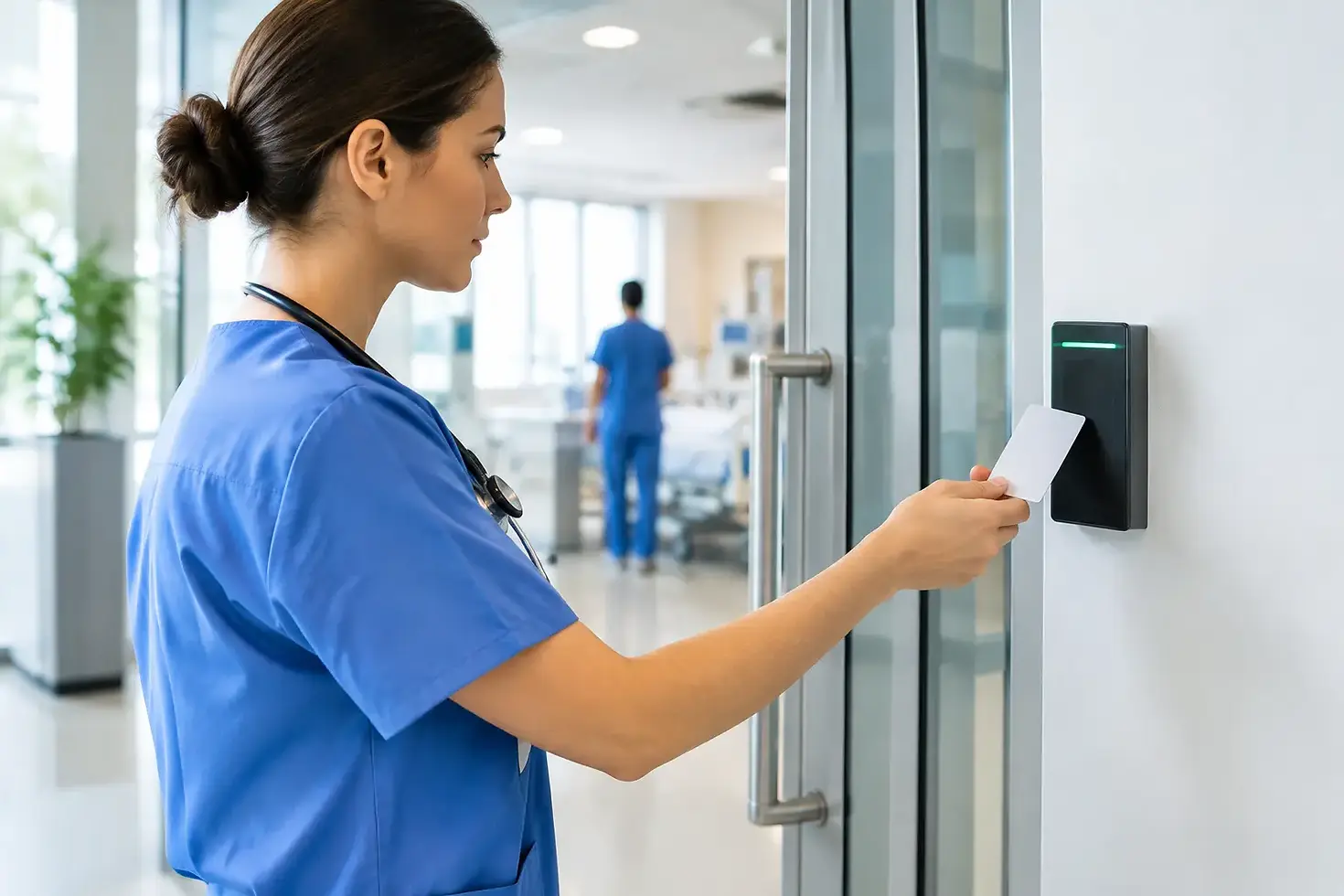
Best Access Control for Hospitals Explained
A hospital door can separate public circulation from a ward, protect controlled medicines, secure patient records or provide a safe route during an emergency. That is why the best access control for hospitals is not a single reader or credential. It is a carefully engineered system that gives the right people appropriate access, records critical activity and supports clinical operations without creating friction at the point of care.
For estates, security and IT teams, the challenge is balancing a highly varied environment. Hospitals are open, time-sensitive and constantly changing. Staff work across shifts, contractors arrive at short notice, patients and visitors must move freely through designated areas, and certain rooms require tight control. A system must be secure, but it must also remain practical when seconds matter.
What makes the best access control for hospitals?
The right solution starts with risk and workflow, not a product catalogue. A small outpatient clinic may need controlled access to staff areas, consulting rooms and plant spaces. A large acute hospital may require a layered estate-wide approach covering public entrances, wards, theatres, pharmacies, laboratories, mental health areas, data rooms, stores and multiple satellite buildings.
Access rights should reflect role, location and time. A nurse may need access to a ward and medicines room during an allocated shift, while an estates contractor may require escorted or time-limited entry to a plant room. Security personnel may need wider permissions, but only with full auditability. This principle of least privilege reduces exposure without forcing teams to manage an unworkable number of physical keys.
A hospital access control system should support four operational outcomes: controlled movement, clear accountability, fast permission changes and dependable continuity. The technology matters, but system design, installation quality and ongoing support determine whether those outcomes hold up over years of daily use.
Design access around hospital zones
Hospitals work best when access control follows a clear zoning strategy. Public areas such as main reception spaces, cafés and waiting areas may be open during set hours. Staff-only corridors, administration offices and stores need a different level of control. High-risk areas require stricter permissions, enhanced monitoring and more detailed event records.
Public and visitor-facing entrances
Main entrances often need a balance between welcome and oversight. Doors may be unlocked during core visiting hours, then controlled out of hours through staff credentials, intercom verification or a managed reception process. Video surveillance can provide useful context for access events at busy entrances, particularly where staff must confirm a caller before releasing a door.
Visitor access should be considered alongside the door system rather than treated as a separate issue. Visitor management can record attendance, issue temporary credentials and support clear rules around permitted locations. For larger sites, this helps security teams distinguish authorised visitors from people who have simply followed others through a door.
Clinical, staff and operational areas
Staff access needs to be flexible. Hospital employees may work across departments, rotate between wards or cover shifts at another location. Centrally managed electronic permissions allow authorised administrators to amend access quickly, rather than recalling keys or changing locks every time a role changes.
Credentials can be issued as cards, fobs or mobile credentials, depending on local policy and user preference. Existing staff ID cards may be suitable for access credentials, which can reduce the number of items a clinician needs to carry. However, the practical decision should account for infection-control procedures, staff adoption, card-printing arrangements and the resilience of mobile devices during a long shift.
High-security and sensitive spaces
Pharmacies, controlled drug cupboards, laboratories, server rooms, medical-records stores and cash-handling locations warrant a higher level of scrutiny. These locations may need individual permissions rather than broad departmental access, with events retained for investigation and audit.
Some doors benefit from dual authorisation, scheduled access or alerts when they are held open. Others may require an electronic lock combined with a high-security mechanical cylinder as part of a wider resilience plan. The correct approach depends on the asset being protected, the building layout and what happens if access is delayed or unavailable.
Mental health settings demand particular care. Door control must protect patients, staff and visitors while supporting dignity, observation and safe clinical practice. Hardware selection, emergency override arrangements and staff workflow should be assessed together. Applying a standard office access model to these environments can create significant operational risk.
Choose technology for resilience, not novelty
Hardwired online doors give central control and immediate event visibility, making them valuable at primary entrances and high-risk locations. Wireless electronic locking can extend access control to more internal doors without the disruption and cost of extensive cabling. Offline or data-on-card solutions can also suit lower-risk doors where central infrastructure is impractical.
In many hospitals, a mixed architecture is the most sensible answer. High-security rooms can be online, key operational routes can use wireless locks, and lower-risk internal doors can be controlled using an efficient offline method. A single management platform can bring these approaches together while allowing the system to expand in phases.
Cloud management can reduce the burden on local servers and give authorised teams secure access to administration from approved locations. It is especially useful for multi-site trusts, private hospital groups and estates with decentralised management. Yet cloud capability should be evaluated alongside network design, account controls, cyber security responsibilities, data retention and contingency arrangements. Remote administration is valuable only when governance is clear.
A technology-led system must also work through disruption. Doors must retain the correct permissions during a network interruption, and life-safety doors must operate in accordance with the fire strategy and applicable standards. Fail-safe and fail-secure decisions cannot be made generically. They must be agreed door by door with fire, security, estates and clinical stakeholders.
Integration turns door events into useful intelligence
Access control produces greater value when it works with the rest of the security estate. An access event at a pharmacy door, for example, can be reviewed against relevant CCTV footage when an incident is reported. An intercom at a restricted entrance can allow staff to verify a caller before granting access. Intrusion detection can alert security teams if a protected area is entered outside authorised hours.
Integration should remain purposeful. Connecting every system without agreed response procedures can create unnecessary alarms and administrative noise. The most effective approach identifies the events that require action, defines who owns the response and makes evidence available when it is needed.
Key management also deserves attention. Even with electronic access on many doors, hospitals retain mechanical keys for plant equipment, cabinets, legacy doors and emergency use. Intelligent key cabinets can control issue and return, record who has taken a key and highlight overdue items. This closes a common gap between electronic door control and traditional key control.
Installation and support are part of the security decision
Hospital estates are live environments. Installation planning must minimise disruption to clinical services, patients and staff, often requiring phased works, out-of-hours activity and close coordination with estates teams. Door surveys need to consider fire doors, frame condition, existing locking hardware, power availability, infection-control requirements and the practical movement of beds, equipment and supplies.
Commissioning is equally critical. Each door should be tested against its intended permissions, emergency behaviour and integration requirements. Administrators need clear training for everyday tasks such as enrolling users, amending access groups, issuing temporary permissions and producing reports. Without that handover, a capable system can become dependent on a small number of individuals or drift away from the original security design.
Long-term service should cover planned maintenance, fault response, software updates and the ability to add doors or buildings as needs change. A specialist partner such as Loktec Security Group can combine access control design, SALTO expertise, installation, commissioning, locksmith capability and nationwide support under one technical delivery model. That continuity is valuable where access control interacts with critical doors, legacy hardware and wider security infrastructure.
A practical route to the right system
Begin with a survey of the estate and a clear list of access scenarios. Identify who needs entry, where they need it, when they need it and what evidence is required afterwards. Include exceptions such as agency staff, emergency contractors, visiting clinicians and temporary room moves, because these are often where informal workarounds emerge.
Then prioritise doors by risk and operational impact. There is little value in applying the same specification to a public meeting room and a controlled medicines store. A staged programme can address the highest-risk areas first while establishing a platform that supports future expansion.
Finally, agree who will manage permissions, who will review audit reports and how the organisation will respond when a credential is lost, a staff member leaves or an incident occurs. Access control is most effective when it is treated as operational infrastructure, not a one-off door project.
The strongest hospital security systems make authorised movement straightforward and unauthorised access harder to achieve. When each door, credential and response process is designed around real clinical activity, security supports safer care rather than standing in its way.


Comments